War Paper
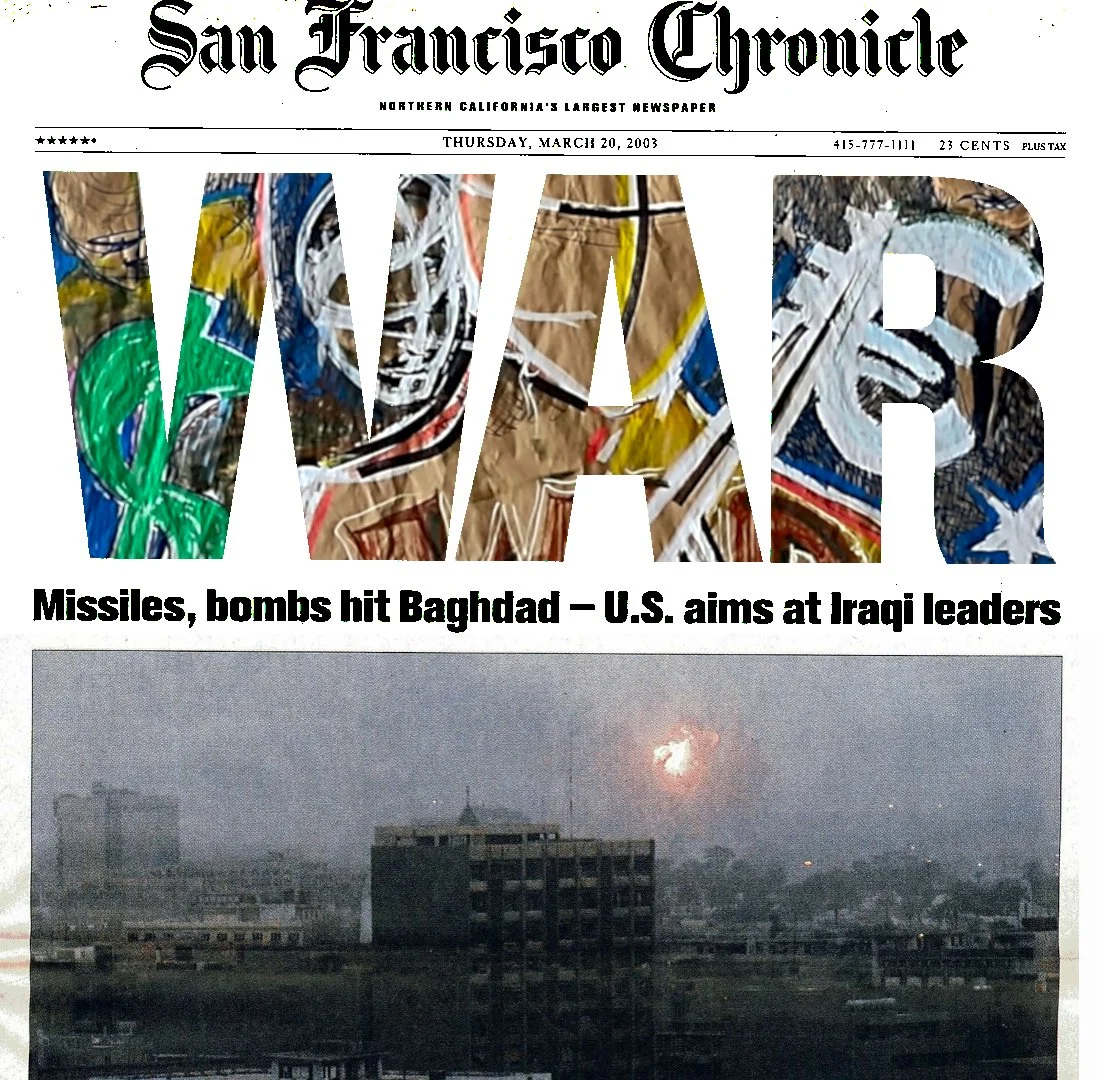
San Francisco Chronicle, March 20, 2003. Composite with detail from War Paper, 2022. © Sharp Art Studio.
On war, witness, and what the studio demands of you
March 20, 2003. Van Nuys, California.
It was a beautiful day. I had walked down Van Nuys Boulevard to one of my favorite chili dog stands and was standing there, taking in the activity on the street, people strolling about with their pets and their children, music coming from a boombox somewhere, when I heard it broadcast from the radio of a car parked nearby: the United States and Coalition Forces had begun to bomb Iraq.
I remember the smell of hot dogs, expressions on the faces of people around me. There had been weeks of political buildup; weeks of hoping it would amount to nothing — and in that moment on a peaceful boulevard in the San Fernando Valley, hope was annihilated.
I remember walking. Slowly, as if in a daze past the James C. Corman Federal Building thinking: what would it be like if a missile hit that building right now? What must it be like if a bomb just slammed into the street, smashing it to pieces, converting asphalt to shrapnel that shreds my vulnerable flesh obliterating me in an instant. What was happening on the other side of the globe I could see in my mind: buildings, streets, people, families, friends, gone. Obliterated. My god. That’s what the people of Baghdad are living right now, I thought.
How could I go home? Back to my comfortable patio and chlorinated swimming pool like nothing significant was happening. I couldn’t. It felt wrong to be contained in a space that was safe and air conditioned knowing that in the name of my country people were being slaughtered. Retaining my sanity would have been a challenge so I walked, staying out until well past dark, moving through the streets not knowing where to go, not knowing how to escape my own imagination. Like a soldier in an urban battle staying on the move was instinctual. The best way to manage the load I was carrying. There was no interior space capable of holding what I was feeling. My spirit could not contain it. If only there was a place I could let it out. I had no studio. No wall to paint on. No canvas large enough. There was only the street. And the long way home.
War had entered my body. I didn’t know it then, but nineteen years would pass before it found its way out.
March 2022. Skid Row. Los Angeles, California.
So I’m in my studio working, moving from easel to easel painting and prepping canvases, a routine that would keep me indoors for weeks at a stretch. I’ve got a huge bay window four floors above San Pedro Street on Skid Row in downtown. Outside, the sky is vast and pastel blue pouring sunlight into the room. I’m in my element and all is right with the world. Or so I thought.
The news broke in my Bluetooth headphones which I wore almost 24 hours a day listening to YouTube: artist lectures, live auctions at Christie’s or Sotheby’s, documentaries on artists ranging from the Renaissance masters to the Post-Impressionists and beyond. But today, media focus was on the Russian invasion of Ukraine. Suddenly Van Nuys Boulevard returned. The sadness, the anger. My mind transported me halfway across the globe as I looked out at the skyline of downtown L.A. and it transformed into what I imagined Kyiv looked like — all I had was my imagination, and it was enough. The people walking on the street four floors below me disintegrating from bombs shattering their world. Where would I take cover from this horror taking place in my mind? What would help me forget that it was taking place in the real lives of real people in a real place; not some hallucinated skyline laminated like a veneer onto my safe, comfortable interior space so incapable of holding what I was feeling? War is hell and so is the helplessness that accompanies it. I needed to do something.
This time, instead of a walk. I went to the wall.
Quickly, I snatched up a pile of brown packing paper marked for disposal on the floor. Flattening it out like a battle plan, I attached it to a wall with tape. Not a new canvas. Not my precious drawing paper. Brown paper. Trash that was going to be thrown away but now was given purpose. It was the biggest surface I had — and I needed something big if I was to throw the tantrum deploying within me. This was no time for making art. And you don’t throw tantrums on your good paper.
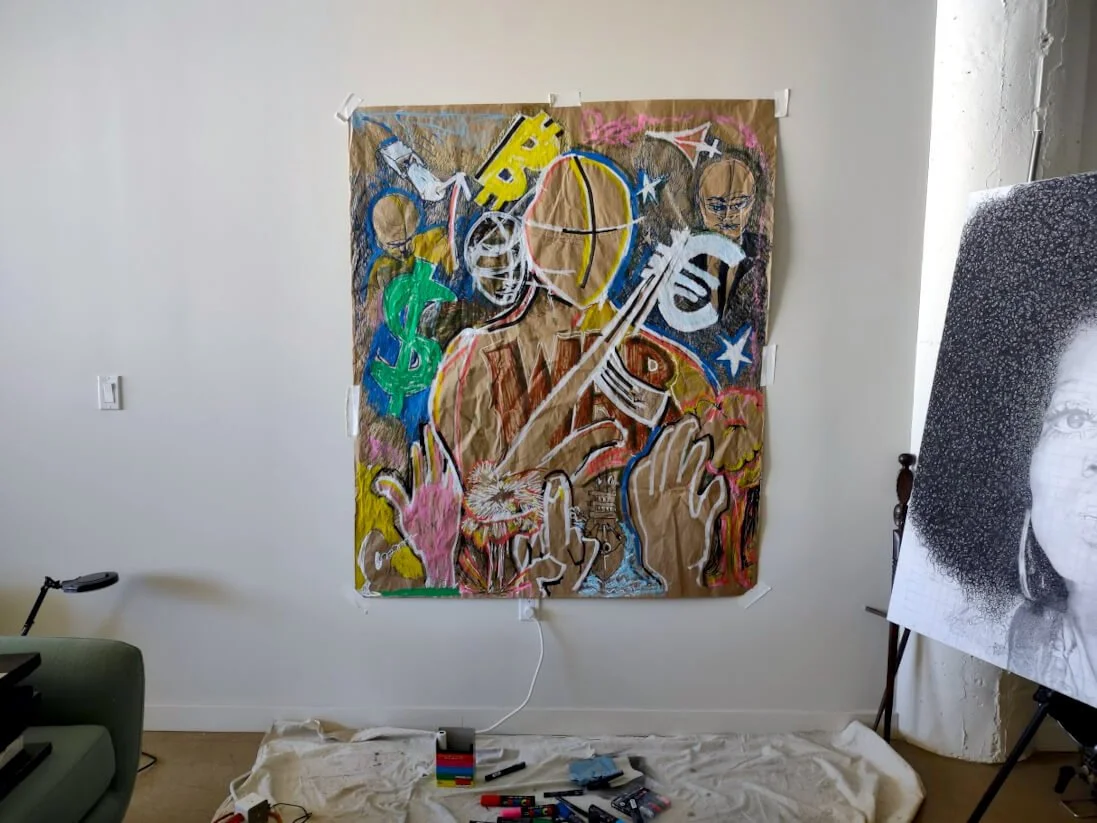
War Paper in progress, 2022. Sharp Art Studio, Los Angeles.
The battle.
What followed over the next several days involved no planning, no forethought, no construction. It was a stream of consciousness flowing through arms outstretched, marks made with the full weight of a body pressing down on them. I was applying force with color and form demanding the surface of the paper absorb something I could not contain.
Days and nights passed and the initial impulse had begun to wane as I stepped back from the wall. I had exhausted myself. What was left on the wall I didn’t evaluate. Like the war just beginning to rage I tried to put the whole thing behind me. I took the paper down from the wall, folded it up and put it away, stored in an ottoman. I knew it didn’t belong with my spare slippers, extension cords, and other studio supplies. It was garish, obscene, chaotic, lacking in rationality at the surface, like the war that was still going. But I didn’t want to think about it anymore. I didn’t want to care whether it was good or bad. I wanted to think of it as something that had simply happened. Nothing to be done about it now except like a white flag waving amid the smoke and fire, put it away and work to forget about it.
The reunion.
Scrolling through Google Photos, I found images I had not looked at in years. Seeing them jolted me like an explosion. As if a rocket had detonated in my face.
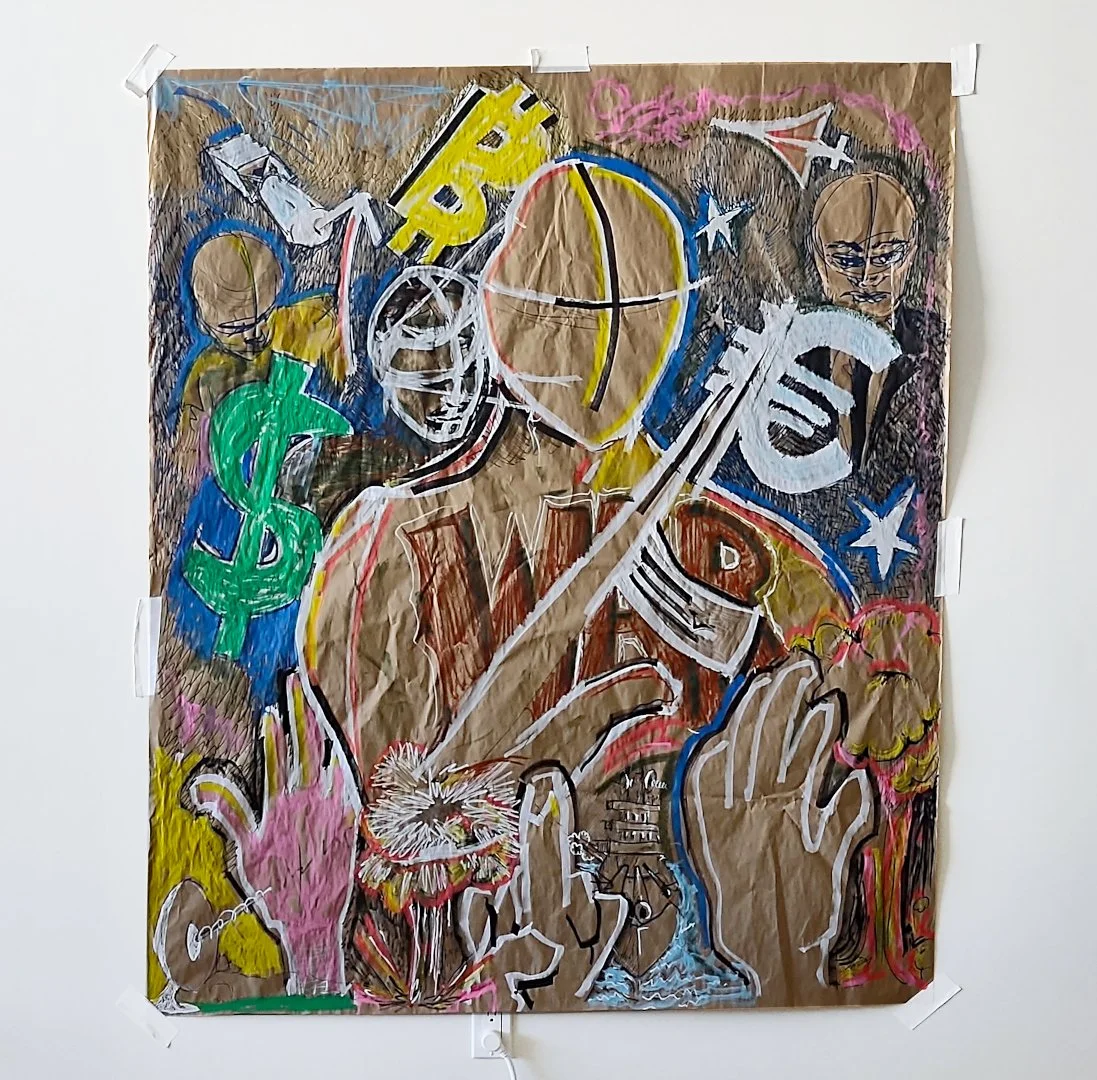
War Paper, 2022. Mixed media on brown packing paper. 63 × 53 in.
All that imagery, all that dynamism, all that energy compressed onto the surface of a creased and battered piece of brown paper — every wrinkle earned. My war drawing. I had made something percussive, something that expressed the physicality of war the way I imagine it: force, chaos, arriving without warning and tearing the known world open.
What I felt looking at it was not pride. More recognition. A reunion. This matters, I thought. Not because of strong composition or technical accomplishment — I am sure it is neither of those things. It is a record. A direct and unrepeatable expression of what one person felt on the day a war arrived. It exists. Irrevocable. Demanded by the moment that made it.
Iraq. Ukraine. Now this.
Have no lessons been learned?
The first two reactions were raw and unplanned — and they still matter. But this moment demands something different. A new piece. Intentional, composed, made on something I care about, with full responsibility for what I am making and why. No tantrums. Statements. An incremental step forward from what came before — because that is what it means to grow as a witness.
Art is war.
The illusion.
In 1937, Pablo Picasso heard the news of the fascist bombing of Guernica — a civilian town carpet-bombed on a market day — and within days he was at his canvas. In five weeks he produced an eleven-by-twenty-five-foot painting that became the most politically powerful artwork of the twentieth century. He didn’t set out to make a masterpiece. He set out to respond. The masterpiece was what honest witness at that level of intensity produces.
I am not Picasso. My brown paper mural is not Guernica. But I understand now, in a way I didn’t when I was attaching that paper to the wall, that I was doing what artists have always done in the face of atrocity. I was bearing witness, refusing to let the moment pass without a record.
Billie Holiday did not wait to sing Strange Fruit until historians confirmed what she already knew. James Baldwin did not wait for permission to write The Fire Next Time. Gordon Parks aimed his camera at the center of conflict. None of them knew, in the moment of making, that what they were doing would last or matter or change anything. They just answered. And the work lasted. And it mattered. And some of it changed everything.
I think about that when I look at my photos. I think about the seemingly endless succession of wars — the sad, terrible illusion that there will always be another one — and I understand now what it means to keep answering. To keep attaching paper to the wall, or stretching the canvas, or sitting down at the page. Making work will not stop the war. But the record matters. Bearing witness is not nothing. Because somewhere in the refusal to turn away, there is something. Humanity.
The next piece is coming. I feel it erupting, boiling, rushing to the surface of my being. That old familiar feeling.
This time I’ll know what I’m doing.
