Raphael and Me
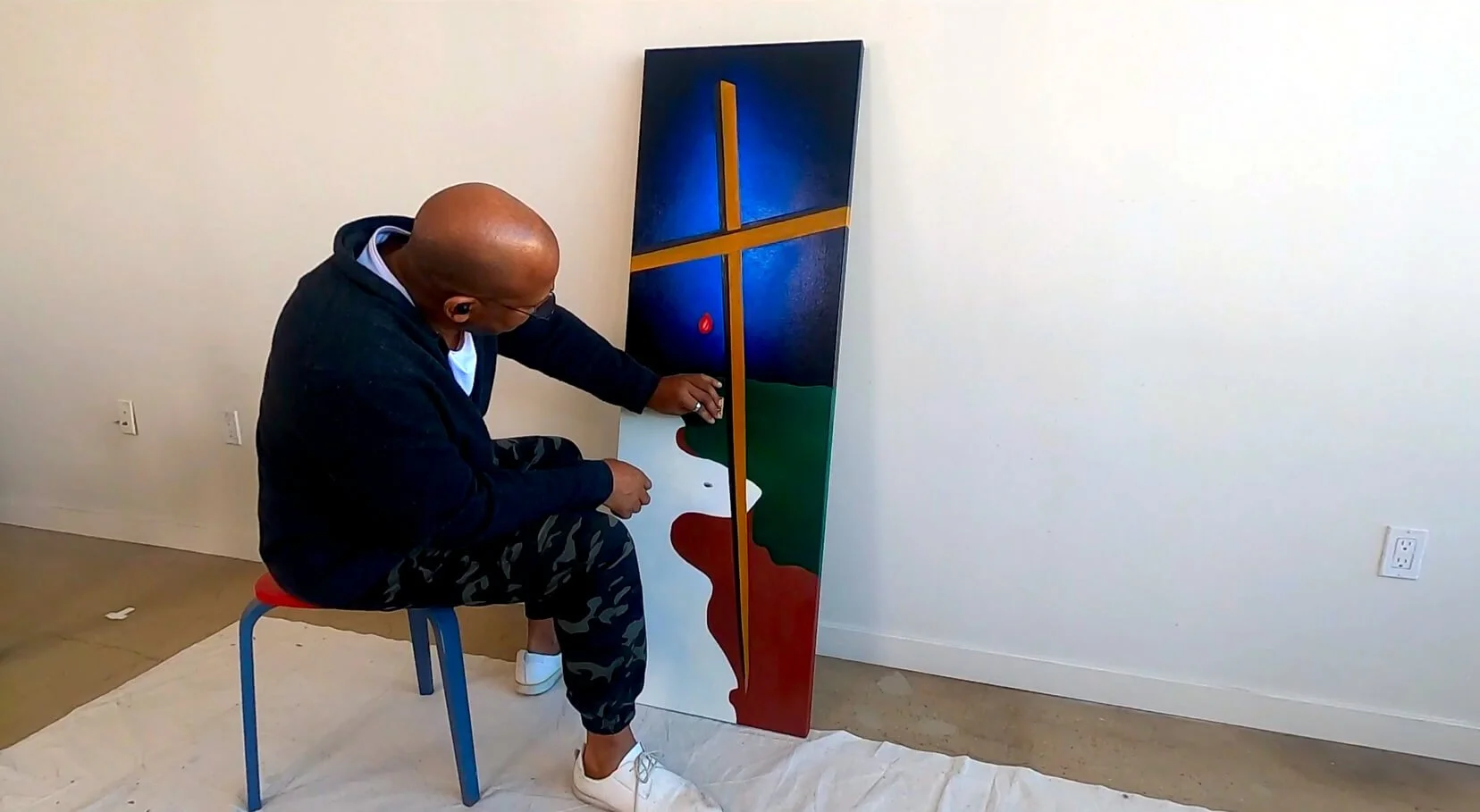
Working on one of my elongated cross paintings in the studio.
It was the kind of day that seemed made for a museum visit. The sky was cloudless. The Southern California sun filled the afternoon with that unmistakable clarity that reminds you why so many people choose to live here. I turned the air conditioning up high, settled into the car, and began the hour-long drive to Pasadena.
It's a city with an elegance that feels both historic and lived-in. Tree-lined streets, stone bridges, beautiful old architecture, modern restaurants and shops woven naturally into the landscape. But I wasn't going there for lunch or to shop.
I was looking for a cross.
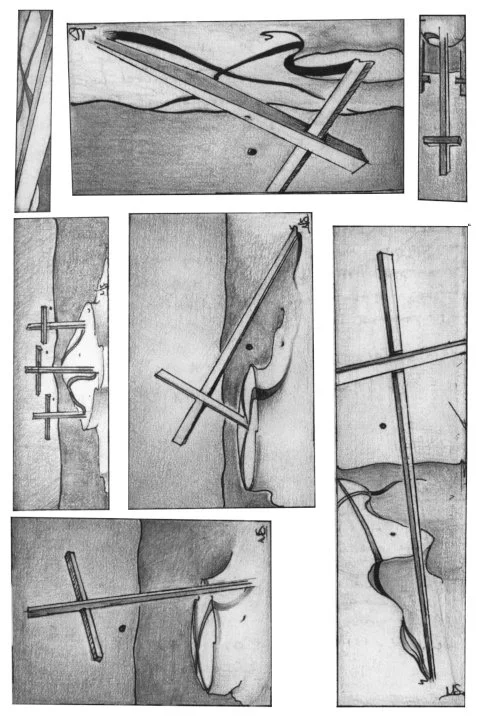
Early graphite studies exploring variations of the elongated cross—a form that has appeared repeatedly in my work.
For many years I've drawn and painted crosses. Occasionally, I draw them long and slender—sometimes like two reeds or twigs bound together. I rarely begin with a set of proportions or calculations for how long the vertical will be in relation to the horizontal. It's simply a form that tends to emerge whenever I begin to draw.
It's a very satisfying process and the results look noticeably different from the broader, more familiar proportions we're accustomed to seeing. My crosses, exaggerated, elongated, appear more fragile by comparison.
I often wonder, is this strange? Will other people find these proportions distracting or worse, sacrilegious? That last possibility bothered me more than I would like to admit.
I rarely see crosses depicted the way I was drawing them. Then I encountered Raffaello Sanzio da Urbino, otherwise known as Raphael, an Italian painter and architect of the High Renaissance. Raphael produced some of the most celebrated paintings in Western art. Now, more than five centuries later, his Madonnas still possess an extraordinary combination of technical mastery, grace and humanity.
But it's not his Madonnas that capture me. It is his crosses: long, thin and delicate, almost as though fashioned from reeds or slender branches. Here was Raphael—depicting the cross in a way that was surprisingly similar to the form that had been appearing naturally in my own drawings for years. For me, it was a significant discovery that stopped me in my tracks.
I'd never studied Raphael before developing this particular way of drawing the cross. I hadn't seen one of his paintings and decided to borrow the idea. For me, the resemblance was entirely accidental, which is precisely what fascinated me.
It didn't prove that my instincts were "correct." It certainly didn't make my work any better. Raphael wasn't reaching across five centuries to give me his approval.
But something did change. The form I had begun to distrust suddenly had a history.
What I had thought might be some peculiar habit of my own hand existed within a much larger visual tradition. One of the great painters of the Renaissance had looked at the same symbol and, for whatever reason, arrived at a similarly delicate and elongated form.
I found there to be something enormously reassuring about that.
As artists we make something because it feels right. We follow our instincts without necessarily knowing where they come from. Then, years later, we encounter an artist from another place or another century who arrived at a surprisingly similar solution. It doesn't mean we are connected in any mystical sense. And it certainly doesn't mean the work is equal. What it does mean is that an idea we thought belonged only to us has been part of the larger conversation of art all along.
Once I discovered Raphael's crosses, I felt a kinship with the man, and I needed to see one for myself. Suddenly, it was important for me to stand in front of one of those paintings and study the cross up close—not on a computer screen or in a YouTube documentary, but as Raphael actually painted it.
So I made the trip to the Norton Simon Museum in Pasadena, home to what the museum identifies as the only Raphael painting in a public collection in the Western United States.
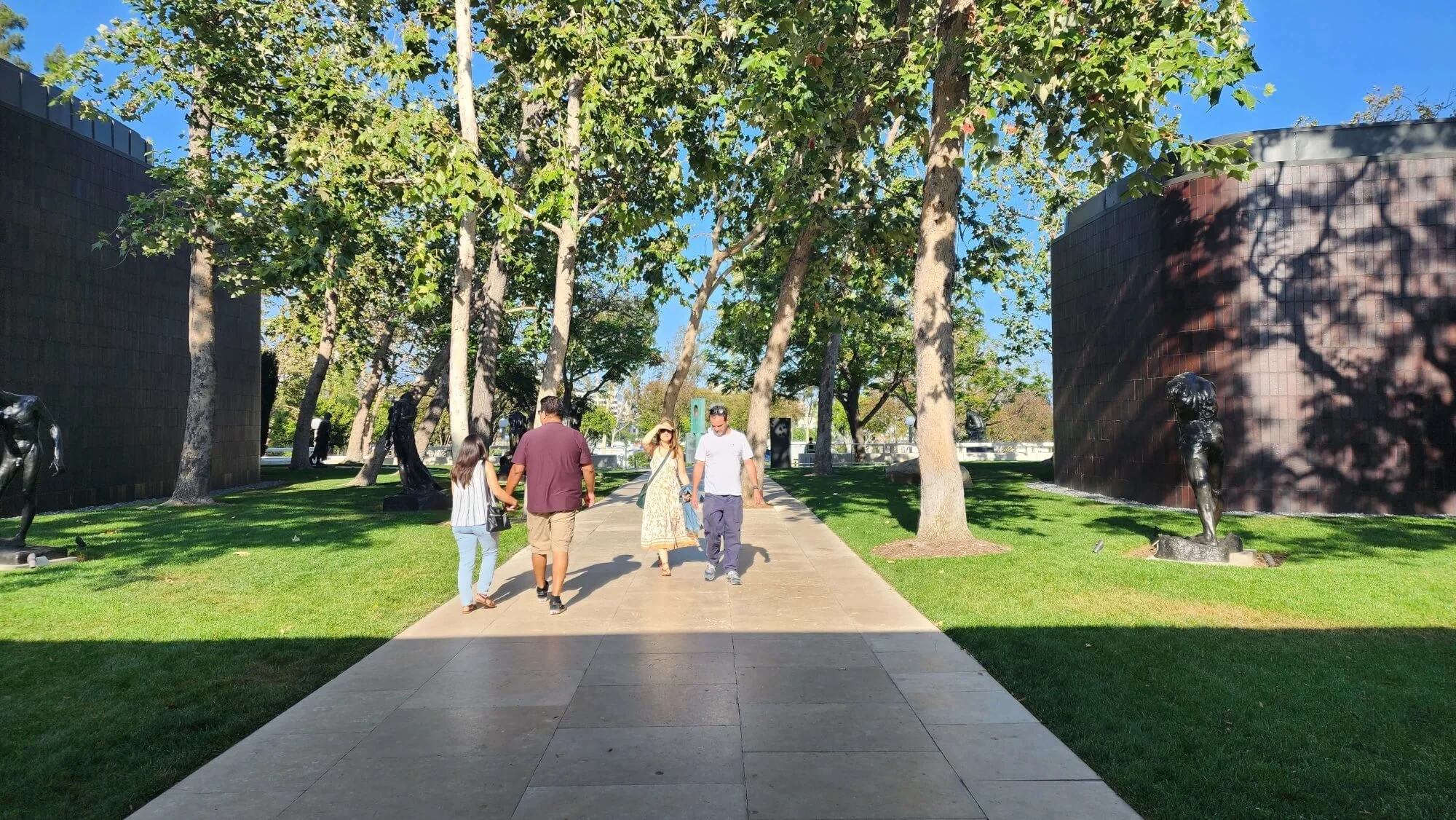
Sculptures welcome visitors along the grounds of the Norton Simon Museum in Pasadena, California.
Walking toward the museum, I was struck by its beauty. Before even entering the building, I was greeted by sculptures arranged throughout the grounds, almost like a welcoming committee. Once inside, I wandered through the galleries for some time, taking in the collection and admiring the beauty of the space before finally asking a docent where I could find what I had come to see.
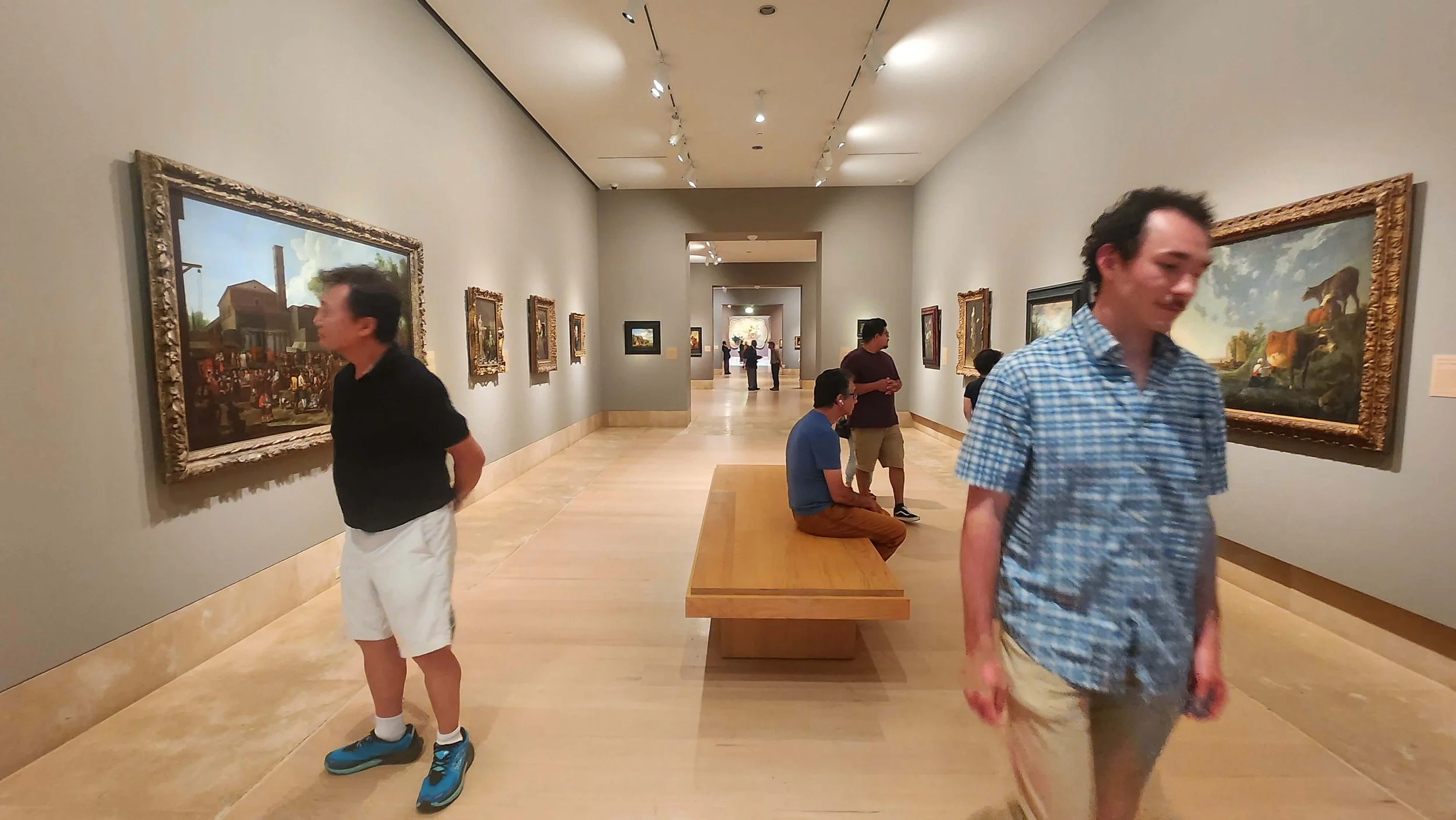
Inside the galleries of the Norton Simon Museum, searching for Raphael.
The docent gave me perfect directions to the opposite side of the museum. And there I found him. Raphael. For some time, I had imagined this moment would be fulfilling, maybe even monumental. But what I found was Madonna and Child with Book, c. 1502–03.
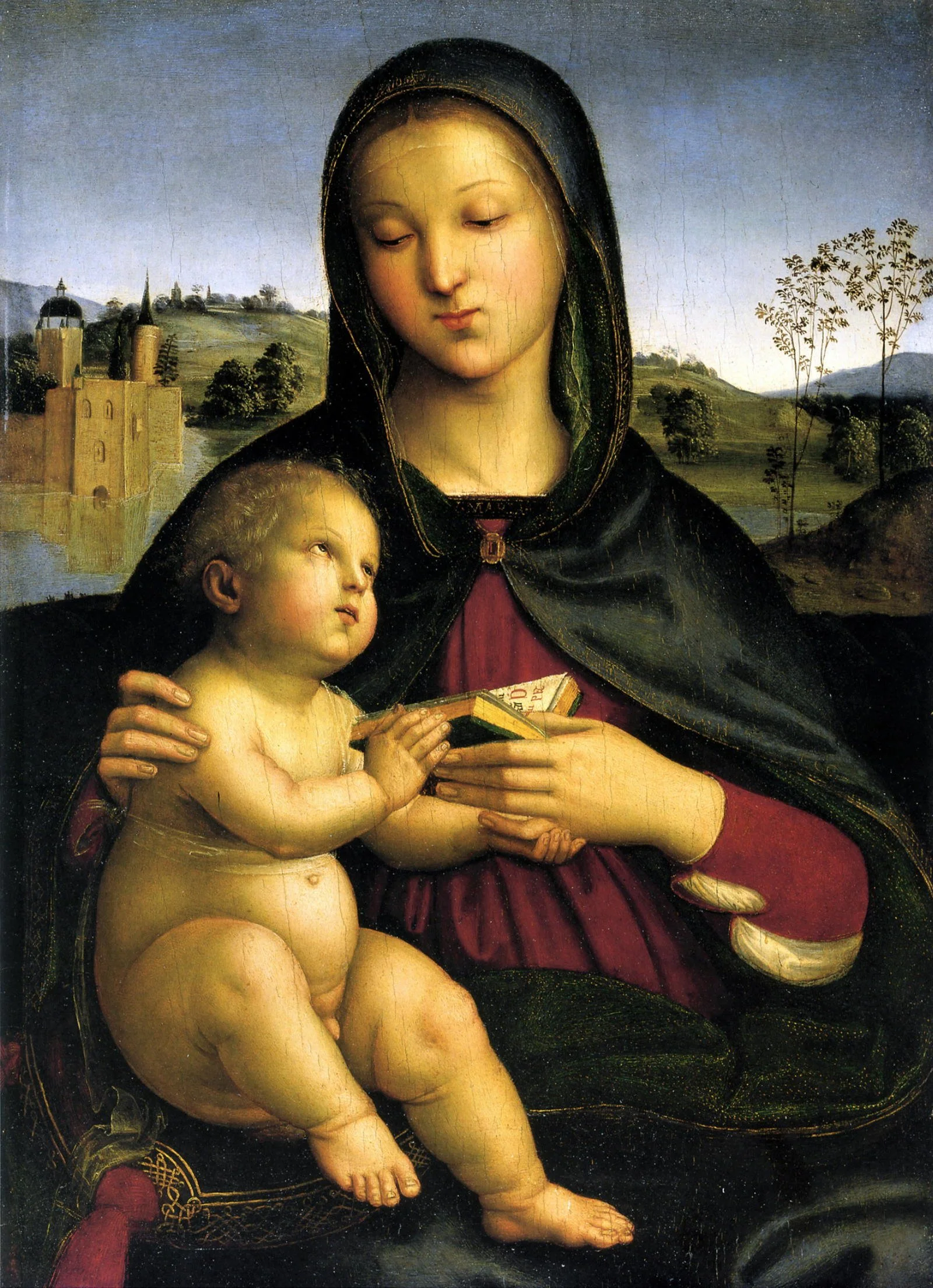
Raphael (Raffaello Sanzio), Madonna and Child with Book, c. 1502–03. Oil on panel. Norton Simon Museum, Pasadena. Public domain image.
It was mesmerizing. A perfectly immaculate painting with an otherworldly quality impossible to deny. It drew me in and kept me there for some time before I realized Madonna and Child with Book does not include the cross in its composition. I had driven all the way to Pasadena looking for Raphael's cross, only to stand in front of a Raphael without one. Still, I was struck by the painting's spiritual quality, and by qualities in the actual object that simply don't come across in a photograph or an image on the web.
There is the craquelure, the fine cracking of paint that comes with centuries of drying and aging. It is evidence that this fragile object has undergone more than five hundred years of stresses, movement and environmental change, yet somehow survived.
And survived magnificently.
The colors are more than vibrant. They are luminous. The brushwork is almost supernatural in the sense that it can be seen and not seen at the same time. The application of pigment is so refined, the attention to detail so complete, that the hand responsible for making the thing almost disappears.
There is an old saying that the devil is in the details.
Standing before Raphael, I found myself thinking the opposite.
God is in the details.
In the devotion to them. In the almost incomprehensible commitment to getting something exactly right. Whatever else one might say about Raphael, standing close to one of his paintings makes the depth of that devotion difficult to ignore.
I had gone to Pasadena expecting to find a compositional detail: the long, thin cross. I left thinking about something much larger. Still, I couldn't entirely escape my disappointment. I had made what now seemed almost like a small pilgrimage, but the cross I had gone there to see simply wasn't there.
Or so I thought.
Later, back in my studio, I began researching Madonna and Child with Book and discovered something I had completely missed while standing in front of it. The little book held between Mary and the Christ Child isn't incidental. The Norton Simon identifies it as a book of daily devotions. Looking closely at the open page, you can make out the beginning of the Latin designation Ad None—the prayer for Nones, the Ninth Hour, the time associated with Christ's death on the cross.
There it was.
Not the cross I had expected. Not two thin pieces of wood intersecting one another. But the Cross was there. Raphael had communicated it without depicting its physical form. Suddenly, my trip to Pasadena seemed to answer the very question that had sent me there in the first place.
My concern had been about taking too much liberty with the appearance of the cross—whether making it unusually long and thin somehow pushed it too far from the form people recognize and expect. Finding Raphael's elongated crosses had given me an initial reassurance, but what I actually found at the Norton Simon took me further than I could have imagined. Raphael didn't merely modify the form of the cross. He didn't show it at all. And yet, its meaning remained.
That's what I needed to find: the reassurance that forms are vehicles. They carry ideas, memories, beliefs and meanings far greater than their dimensions. The form can change. It can be elongated, exaggerated, made fragile. It can even disappear from sight while the idea it carries remains completely intact.
I had gone to Pasadena looking for Raphael's cross. Instead, I found his devotion, his extraordinary attention to detail, and a painting that revealed more in person than any reproduction had shown me.
What I went all the way to Pasadena to find revealed itself only later, after I had returned to the place where the whole question began.
My studio.
